Umbwe Route Overview
Route overview, difficulty, success rates, itinerary, and expert tips
Overview of the Umbwe route
Umbwe route is a less popular trail that deserves attention. In the past, it was perceived as a difficult route. However, while it is steeper in the first two days, the route is still suitable for many Mount Kilimanjaro trekkers. It begins on the southern side of Mount Kilimanjaro, converging with Lemosho route and Machame route on the third day before the Barranco Wall. A key characteristic of Umbwe is that during the first two days you will hardly see other trekkers. It’s available in 6 or 7-day itineraries, with the seven-day option being the recommended one for beginners without prior acclimatization. Overall, it’s a very scenic route that will allow you to see some of the best views on Kilimanjaro, traverse all of the mountain’s climatic zones, and observe its unique plants and animals.
Safety first: To maintain our strict safety standards, mountain expeditions are available only to participants aged 12–70 years.
Discover what makes us the one of the most trusted and well-prepared Kilimanjaro operator, from safety and training to every detail on the mountain.
Expert recommendation
The difference between the Umbwe and Machame routes primarily lies in their initial two days. The steepness on Umbwe averages 21.5% for these days, whereas on Machame, it’s about 17%. This makes Umbwe a bit more challenging in the beginning. After that, the trek becomes more moderate. We strongly recommend the 7-day variation, with an extra night at the Barranco camp, for its better acclimatization profile.
Kilimanjaro Expedition Coordinator|Tanzania
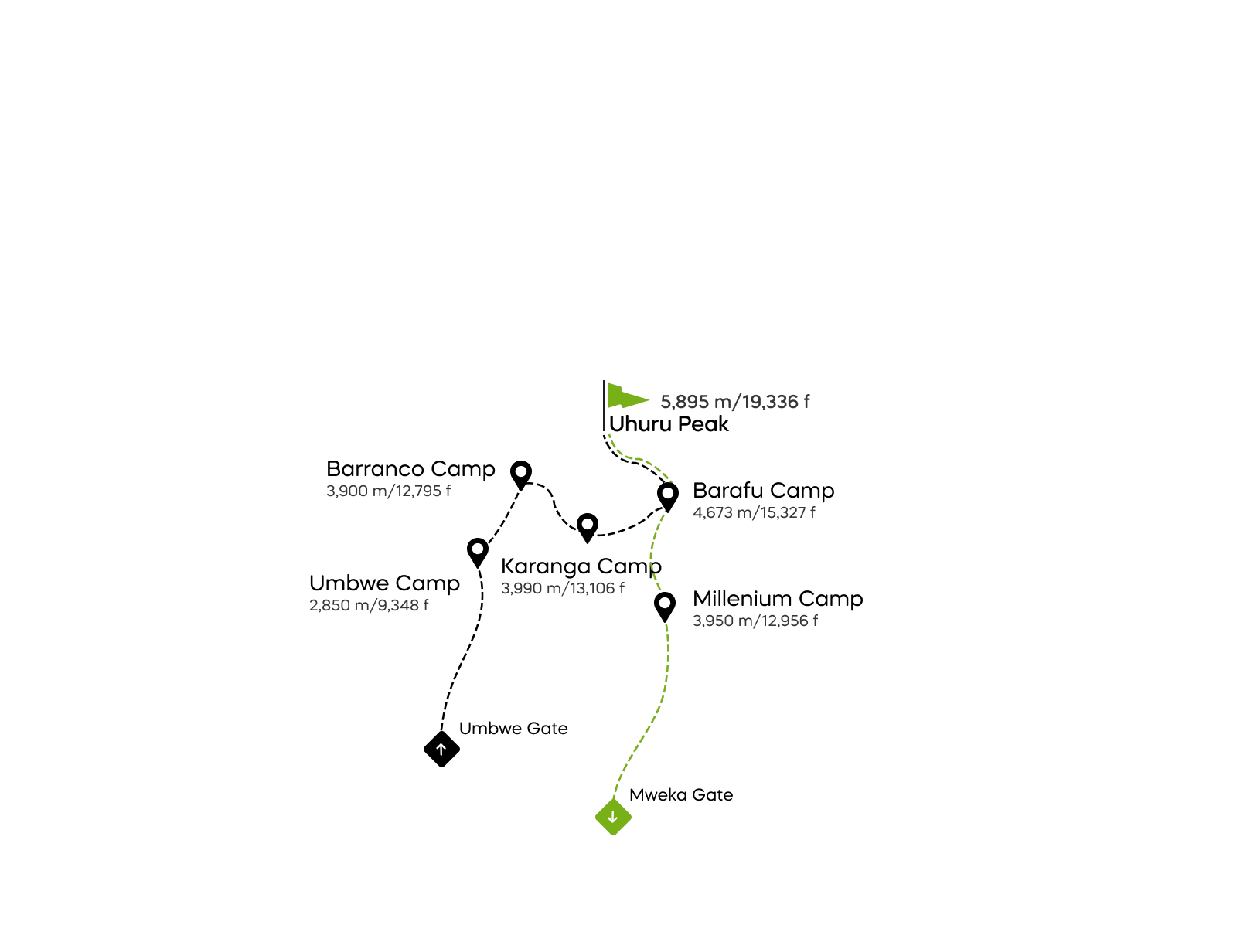
Umbwe route on the Kilimanjaro map
Get PDF Kilimanjaro Packing List
Free Kilimanjaro Packing List with gear necessary for the hike and recommendations from Nuru experts.
Join our Kilimanjaro Climbs
Umbwe Route – Summit Success Rate
We at Altezza have been organizing Mount Kilimanjaro expeditions for over 10 years and have gathered detailed data on summit success rates for each route. Umbwe route was traditionally available in 6-day itinerary, while the 7-day variation is our latest addition. Here’s the Umbwe route summit success rate:
Umbwe route 6 days – Uhuru Peak: 97.1% ; Crater Rim: 97.8%
Umbwe route 7 days – N/A. Very likely to be even higher.
The summit success rates for Umbwe 6 are really impressive, aren’t they? However, we must note that due to its perceived reputation, the route is often chosen by very strong trekkers who make it to the top despite any challenges. The summit success rate for the average person might be a little lower, being similar to Machame 6 – close to 90%. However, the good news is that we are now offering a new 7-day itinerary, which will boast a more gradual acclimatization profile and less demanding transitions.
Few operators can boast such summit success rates not just on paper but in practice. Our Wilderness First Responder-certified guides conduct two medical check-ups per day and are ready to offer help at any moment if somebody feels unwell because of the altitude. The largest inventory of oxygen tanks in the region, as well as in-depth safety protocols and extensive medical kits, allow us to make your acclimatization as comfortable and safe as possible. Since the most challenging thing when climbing Mount Kilimanjaro is the high altitude, it’s essential to choose a Kilimanjaro operator that will prioritize your well-being, thus giving you the best chances of summiting.
Want to plan a memorable Tanzanian adventure? please contact our guest experience experts
Agatha // Online
WhatsApp Chat Online
 BASED IN TANZANIA
We are always here to help
Umbwe Route Detailed Itinerary
Book this ClimbFull itineraryShort itinerary
DAY 1

Arrival
Arrival at Kilimanjaro International Airport (JRO), where you will meet ypur guest experience expert and representative, and transfer to the hotel under the rate. The hotel will provide all the essentials for a comfortable stay: cozy rooms, hot water, polite staff, a swimming pool, and Internet access. In the evening there will be a briefing with our managers, who will also make sure you are ready to begin the climb.
Private tour packages include shared airport transfers for your group. Extra charges will apply for additional individual transfers. To avoid extra costs, sync your group’s arrival and departure times.
PLEASE NOTE:Check-in starts at 2:00 PM.
DAY 2

Trekking from Umbwe Gate to Umbwe Camp
Your guide and climbing support crew will arrive at your hotel in the morning. Introductions and the final brief equipment check will precede your drive to the Umbwe Gate of Kilimanjaro National Park. This entrance, situated at 1,800 m /5,904 f above sea level, is where your trek starts. The chief guide will finalize the permits and registration for search and rescue services.
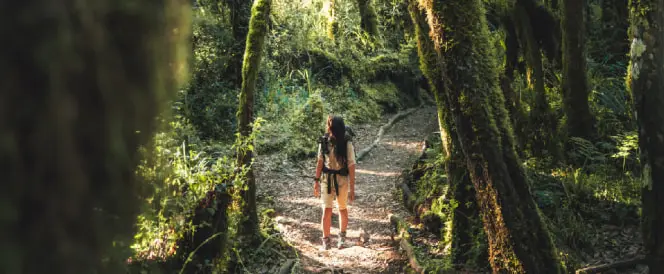
Your first day of trekking is meant to bring you to Umbwe Camp for your first overnight camping. Climbing up to 2,850 m /9,348 f is a long haul with a significant increase in altitude, so find the right pace for the whole group and stick with it. As this part of the Umbwe route goes through the rainforest, there is a high probability of rain showers – do not forget your raincoat! Your support crew will have prepared the camp and dinner by the time you arrive at the camp.
PLEASE NOTE:This will be your first day at this altitude, so it is strongly recommended you heed the following instructions from this point on:
- Drink over 4 liters of bottled water daily (little by little, frequently);
- To help alleviate symptoms of altitude sickness, consider using a preventive measure like a high-altitude aid medicine. Many mountain climbers take such pills in the morning, before they begin their ascent, to reduce discomfort associated with altitude sickness. Our managers will provide more specific details together with your travel itinerary. We recommend consulting your doctor prior to the trip to discuss any potential allergies or health concerns.
At night you may experience discomfort associated with acclimatization to the high altitude: because of a reduction in your breathing pattern at night, your body gets less oxygen than during the day. Taking altitude into account, you may therefore start feeling sick and experience a headache. Pay attention to your own body and tell your guide if you start feeling any symptoms of altitude sickness.
 Trekking time: 5-7 hours
 Distance: 11 km (6.8 miles)
DAY 3
Trekking from Umbwe Camp to Barranco Camp
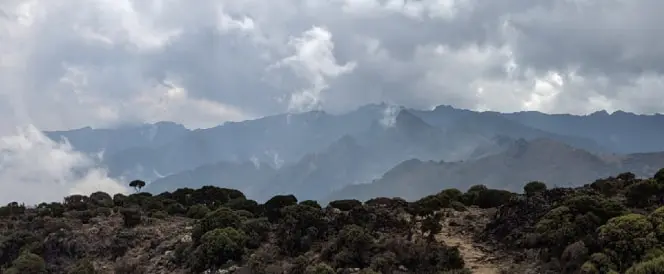
This day starts with an early wake-up and filling breakfast before your team starts the trek to Barranco Camp. The rainforest will quickly give way to moorland, and if it is not too cloudy you will be able to see Meru Volcano for the first time. This day’s trek is moderate in length and around lunchtime it is expected that you will reach Barranco Camp (3,900 m /12,792 f), which is nestled inside a huge volcanic fault. Lunch will be provided here, and then you will have the opportunity to relax for the rest of the day, which significantly facilitates the acclimatization process.
Trekking time: 4-5 hours
Distance: 6 km (3.7 miles)
DAY 4
Trekking from Barranco Camp to Karanga Camp
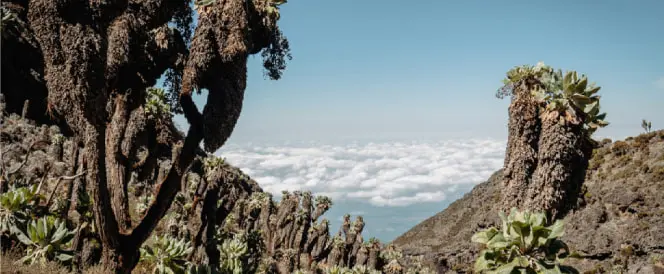
This day begins with another early wake-up and a filling breakfast before your group starts to climb Barranco Wall. We recommend you leave the camp as early as possible to avoid other groups and crowds on the way, which can slow you down. Hiking up the gorge wall is not difficult and only takes around an hour. After the climb, you can have a rest and take photos in front of the Kibo volcano.
Then you will start a more difficult hike to Karanga Camp, which features numerous ascents and descents during the route, but don’t worry: our guides are experts at choosing an optimal pace for the group. After reaching the camp you will be offered warm lunch. After a couple of hours, you will have to go on an acclimatization hike in the direction of Barafu Camp with a 200 m /656 f gain in altitude and then descend back down to the camp.
PLEASE NOTE:The acclimatization hike is an easy trek with a slight gain in altitude done in order to speed up the acclimatization process. You should take the acclimatization hikes very seriously. They help increase your chances of successfully summiting Kilimanjaro and save you from the consequences of altitude sickness.
Acclimatization hike //  Change in Elevation:
Karanga Camp (3,995 m / 13,106 ft) // Destination point en route to Barafu Camp (4,270 m / 14,009 ft)
Hiking distance: 2.5 km (1.5 miles)
Hiking time: 1-2 hours
Trekking time: 4-5 hours
Distance: 5 km (3.1 miles)
DAY 5
Trekking from Karanga Camp to Barafu Camp
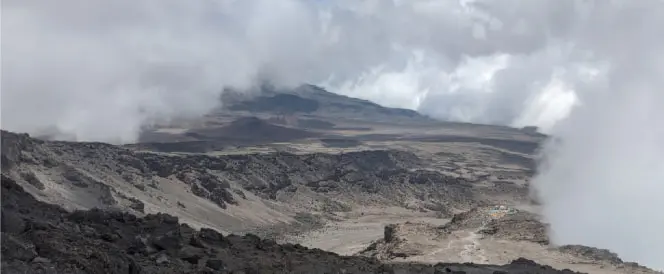
In the morning after breakfast, you will begin your hike to Barafu Summit Camp (4,673 m /15,327 f), the starting point for the night summit of Uhuru Peak (5,895 m /19,336 f). Our team will set up a camp for you ahead of time, including tents and sleeping bags, so you can relax as soon as you arrive. After regaining strength, you will need to go on an acclimatization hike towards the intermediate Kosovo Summit Camp (4,870 m /15,974 f) and then back to Barafu Camp, where you will be served a hot dinner. It is better to spend the remainder of the day resting and sleeping before the night summit.
Acclimatization hike // Change in Elevation:
Barafu Camp (4,673 m / 15,331 ft) // Kosovo Camp (4,870 m / 15,977 ft)
Hiking distance: 2 km (1.2 miles)
Hiking time: 1-2 hours
Trekking time: 4-5 hours
Distance: 6 km (3.7 miles)
DAY 6
Ascent to Uhuru Peak and Descent to Millennium Camp
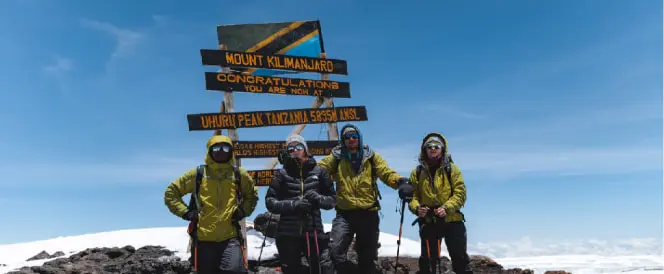
The group leaves Barafu Camp at around midnight. This night you will climb to the top of Kilimanjaro, to Uhuru Peak (5,895 m /19,336 f). Although the trek itself is not difficult, the high altitude means that even regular physical activity feels strenuous. For the final summit, we pair every two climbers with a personal guide whose responsibility it is to monitor their physical and mental well-being more closely. Upon reaching Uhuru Peak you may choose to walk to one of Kilimanjaro’s glaciers. The group will then return to Barafu Camp for a 2-hour rest before the descent to the Millenium Camp at 3,950 m /12,956 f.
Please note that while descent brings relief from high altitude, it is also where most accidents and injuries (as much as 90%) happen. It is easy to avoid falling and possibly breaking a limb, as well as damaging your toenails if you just watch your step.
Trekking time: 8-12 hours
Distance: 15 km (9.3 miles)
DAY 7
Descent from Millennium Camp to Mweka Gate
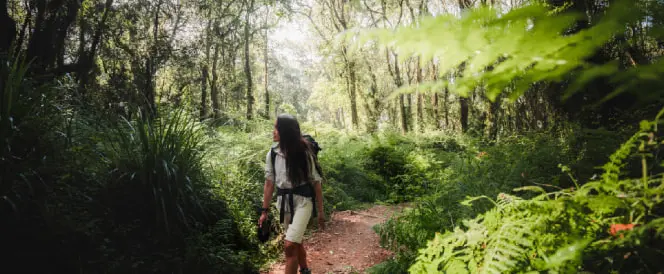
Millennium Camp sits amidst a rainforest. The lower altitude, as well as the realization of having reached your goal, make for a good night’s sleep. The group will set out on the last leg of the journey towards Mweka Gate – national park exit (1,640 m /5,379 f) upon finishing breakfast. This will be your last opportunity to share memories of the climb with your guides and support team. You will receive your certificates of accomplishment at our offices before being driven back to your hotel.
Trekking time: 4-5 hours
Distance: 12 km (7.4 miles)
DAY 8

Departure
Rest in the hotel and transfer to the airport.
PLEASE NOTE:Hotel check-out is at 11:00 AM. In case you need a late check-out because of an evening flight, there is the option to extend your hotel stay for an extra fee.
Prices for Umbwe route
Classic Premium // Classic Tarif
Our classic adventures are what the majority of climbers are looking for. The combination of great comfort and high safety standards makes our classic Kilimanjaro hikes enjoyable and memorable. This is the most popular option among our clients.
This climbing package includes everything that a climber may need for the hike – our experienced mountain crews, high-quality group equipment, nutritionist-designed meals. Our safety protocols, though, are the same for all our hiking adventures – only the guides with Wilderness First Responder certification are assigned to lead a party. Other safety measures include a supply of oxygen cylinders, complete medical kits and compulsory medical check-ups (two per day).
The progress of each trekking party is tracked with GPS device. You may share the link with your family and friends, who will be able to monitor your progress in a real-time mode.
Before and after the adventure you will stay in a good hotel with caring staff, hot water, reliable Wi-Fi, restaurant and swimming pool.
 Umbwe route price per person book this Climb
Want to plan a memorable Tanzanian adventure? please contact our guest experience experts
Agatha // Online
WhatsAppChat Online
BASED IN TANZANIA
We are always here to hel

52 reasons to climb Kilimanjaro with Nuru Expeditions
 Climbing Cost Includes

All transfers

Hotel before and after the hike

Camping equipment

Meals on the hike

Professional guides and porters

Oxygen tanks

GPS Trackers

Medical check-ups, fully-loaded medical kits, and in-company doctor

Fully-loaded medical kits

24/7 Support via Satellite Phone

All park fees and taxes

Dedicated support team

Innovative and user-friendly travel planning portal

Safe room and storage room

Leave No Trace adventure

Impactful change for the local communities
 Climbing Cost Excludes

International flights


Single supplement

Travel insurance

Portable toilet

Lunch and dinner in the hotel
Umbwe Route FAQ
Umbwe route vs Machame route
The only difference between Umbwe 6 and Machame 6 lies in the first two days of the hike. Umbwe route is a relatively steep climb in the first two days, but with hardly any trekkers in sight, while Machame is busy all the way. On the third day, they converge and continue as a single route via the southern circuit, the Barranco wall, and all the way to the summit. We highly recommend choosing the 7-day itineraries as they provide significantly better acclimatization, with enough time for your body to adjust to the altitude.
Umbwe 6 vs Western Breach
Umbwe route and Western Breach are sometimes considered to be the shortest and hardest Kilimanjaro routes. However, the second statement is debatable. The 6-day Umbwe route itinerary is challenging due to the steep hikes during the first two days and less time to fully acclimate to the altitude. On the other hand, the distinct feature of the Western Breach is not difficulty per se, but the danger of rockfalls and the challenge of finding a safe path up.
If you’re a seasoned trekker seeking a challenge, the Umbwe 6 route is an excellent choice. While our guides are skilled in navigating the Western Breach, it’s crucial to recognize the inherent risks of this Kilimanjaro route. It’s only recommended for those fully aware of these challenges and unwavering in their decision to proceed.
What is the success rate of the Umbwe route?
According to Nuru Expeditions statistics, over 97% of hikers make it to the top on the Umbwe route. However, keep in mind that the majority of those stats are from trekkers with a higher-than-average level of experience who’ve chosen Umbwe knowing that it provides a challenge.
For beginners, we’ve created a new 7-day itinerary, that will be slightly easier, while maintaining the high success rate.
How long is the Umbwe route?
The Umbwe route is approximately 53km or 32 miles long, with the longest hike on the summit night. It’s one of the shortest routes up Kilimanjaro’s summit. The most challenging route section is the final summit day, when you need to hike all the way to Uhuru Peak in the alpine desert zone. However, no technical skills or special equipment other than trekking poles will be required. The descent goes via the Mweka route.
How long does the Umbwe route take?
The Umbwe route is available in two itineraries: 6 or 7 days in the mountains. The longer itinerary is recommended for everyone without prior acclimatization and experience. Some operators offer “budget” options of a 5-day climb, but those are much harder with very low summit success rates.